Resilient by Design: Backend Systems That Hold Under Load
A practical deep-dive into building backend systems that stay stable under pressure — using queues, caching, retries, and observability as your first line of defense.
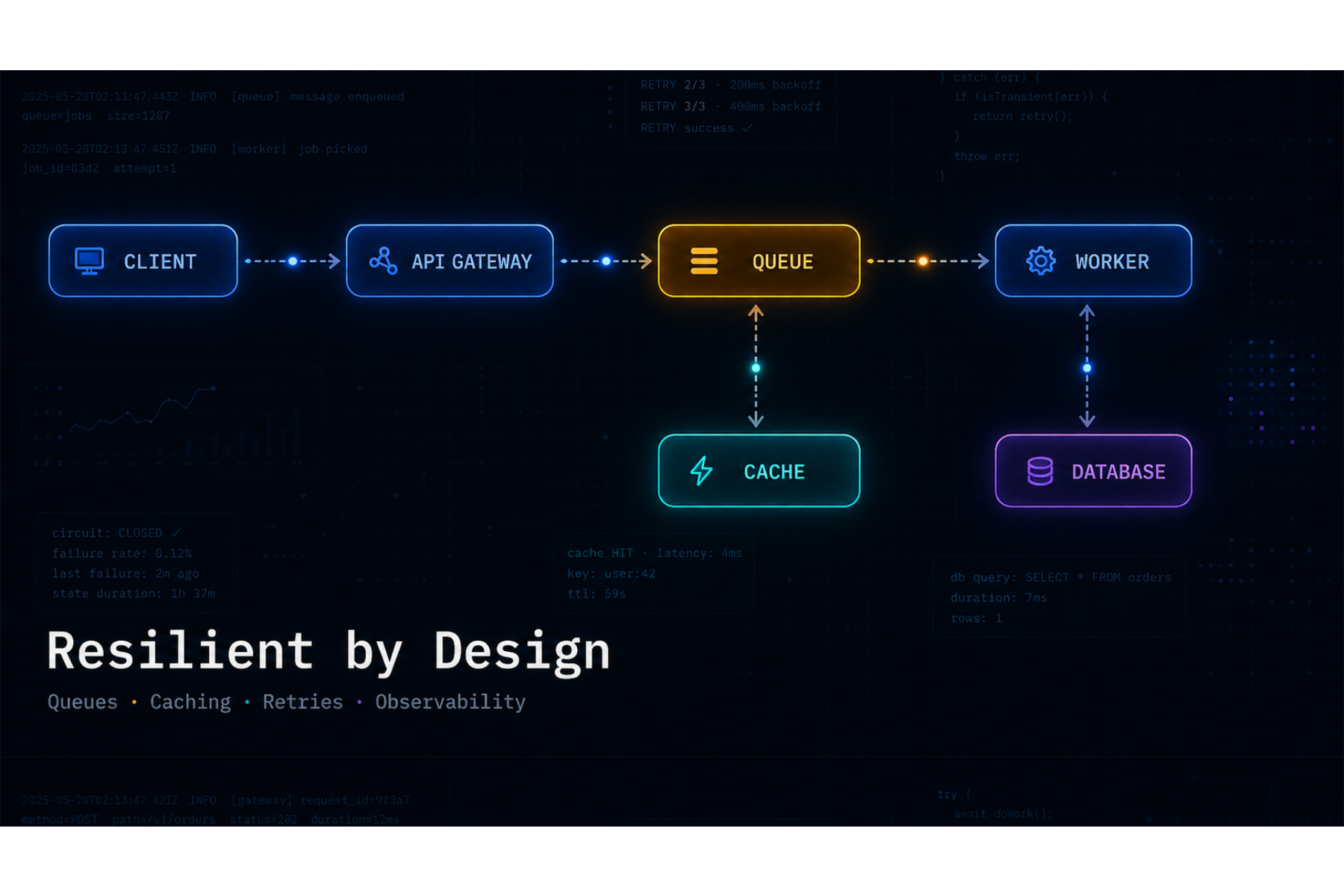
Production systems lie. Everything runs perfectly in staging, your tests go green, you deploy — and then traffic hits. A third-party API starts timing out. A database connection pool exhausts itself. A downstream service goes quiet. Your app, unprepared, tumbles with it. Resilience isn't a feature you add at the end. It's a mindset baked into how you architect, instrument, and reason about your systems from the start. This note walks through four foundational pillars — queues, caching, retries, and observability — and how they work together to keep your backend standing when things inevitably don't go as planned.
The Fragility Trap: When Everything Depends on Everything
The easiest systems to build are also the most brittle: one service calls another, which calls a database, which calls an external API — all synchronously, all in the critical path. It works until it doesn't. The moment any single node in that chain slows down or fails, the failure propagates upstream like a shockwave. Users see errors. Queues pile up. Engineers get paged.
"A distributed system is one in which the failure of a computer you didn't even know existed can render your own computer unusable." — Leslie Lamport
This isn't a scare tactic — it's the baseline reality of any system that talks over a network. The good news? You can design against it.
Queues: Decoupling the Work from the Worker
Message queues are one of the most powerful tools in a backend engineer's kit. Instead of service A waiting for service B to finish processing a request, A drops a message into a queue and moves on. B picks it up and processes it at its own pace. This simple shift unlocks a lot: you get natural load leveling (spikes get absorbed rather than amplified), independent scalability (scale producers and consumers separately), and failure isolation (if B goes down, messages wait — they don't vanish). Tools like RabbitMQ, Kafka, and cloud-native options like AWS SQS each make different trade-offs around ordering, durability, and throughput. The right choice depends on your use case — but the pattern itself is universally useful.
"The queue is not a workaround. It's a contract — a promise that the work will get done, just not necessarily right now."
A dead-letter queue (DLQ) is your safety net here: messages that fail repeatedly get parked for inspection rather than silently dropped. Always configure one.
Caching: Don't Recompute What You Already Know
Every expensive computation or network call you don't have to make is latency you've saved and load you've shed. Caching is how you stop asking the same questions twice. At its simplest, you cache the response to a database query or an external API call behind a fast key-value store — Redis being the classic choice. But caching done carelessly introduces its own failure modes: stale data, cache stampedes (every key expires at once and hammers the database), and cache poisoning. A few patterns help here. TTL (time-to-live) gives every cached entry a natural expiry. Cache-aside (lazy loading) means you only populate the cache on a miss, keeping it lean. Write-through caching keeps the cache and the source of truth in sync on writes.
"A cache is a bet that the future will look like the past. Know when that bet is worth making."
The real discipline is knowing what to cache, for how long, and how to invalidate cleanly — because as the old joke goes, cache invalidation is one of the two hardest problems in computer science.
Retries and Circuit Breakers: Trying Again, Gracefully
Transient failures are everywhere — a blip in network latency, a momentary overload on a downstream service. A well-placed retry can be the difference between a failed user request and one that succeeds on the second attempt. But naive retries are dangerous. If ten thousand clients all retry simultaneously the moment a service hiccups, you've just turned a transient failure into a sustained one — the thundering herd problem. The fix is exponential backoff with jitter: wait a little, then a little longer, with randomness added to spread the retry load out. The circuit breaker pattern takes this further. If a downstream service is consistently failing, stop calling it — open the circuit. After a timeout, let a few requests through to test recovery. This prevents your service from wasting resources hammering a service that's already down.
"Retrying blindly isn't resilience — it's optimism with consequences. Retry intelligently, and back off gracefully."
Libraries like Resilience4j (Java/Kotlin) and Polly (.NET) make circuit breakers straightforward to implement. Most cloud SDKs have retry policies built in — use them, and tune them.
Observability: You Can't Fix What You Can't See
Queues, caches, and retry logic make your system resilient — observability is what lets you know it's working and find out when it's not. The three pillars of observability are logs, metrics, and traces. Logs tell you what happened. Metrics tell you the shape of your system's behavior over time. Distributed traces let you follow a single request as it hops across services — invaluable when debugging a latency spike. Instrument the things that matter: queue depth and consumer lag, cache hit rates, retry counts and circuit breaker state, p95/p99 latency per endpoint. Surface these in dashboards. Set alerts on the signals that actually indicate user impact, not just noise.
"An observable system doesn't just fail gracefully — it fails visibly. You should know about the problem before your users do."
Tools like Prometheus + Grafana, Datadog, or OpenTelemetry give you the raw capability. The skill is in knowing which signals are leading indicators and which are just noise — and that intuition only comes from building dashboards you actually use.
Decouple aggressively
Synchronous, in-the-critical-path dependencies are fragility in disguise. Queues let your components breathe independently — and fail independently.
Retry with intention, not desperation
Retries save you from transient failures, but only when combined with backoff, jitter, and circuit breakers. Uncontrolled retries amplify failures rather than absorb them.
Observability is not optional
Resilient patterns protect your system in the dark. Observability turns the lights on. Build both — and instrument before you're in an incident, not during one.
Backend resilience isn't glamorous work. There's no viral demo for a retry with jitter or a well-tuned cache eviction policy. But these are the patterns that earn trust — from your users, your teammates, and your future self at 2am looking at a dashboard that tells you exactly what's wrong. Build systems that expect failure. Because they will encounter it.