Design Systems as Product Memory
A design system isn't just a component library — it's the institutional memory that keeps your product coherent, your team fast, and your users at home on every screen.
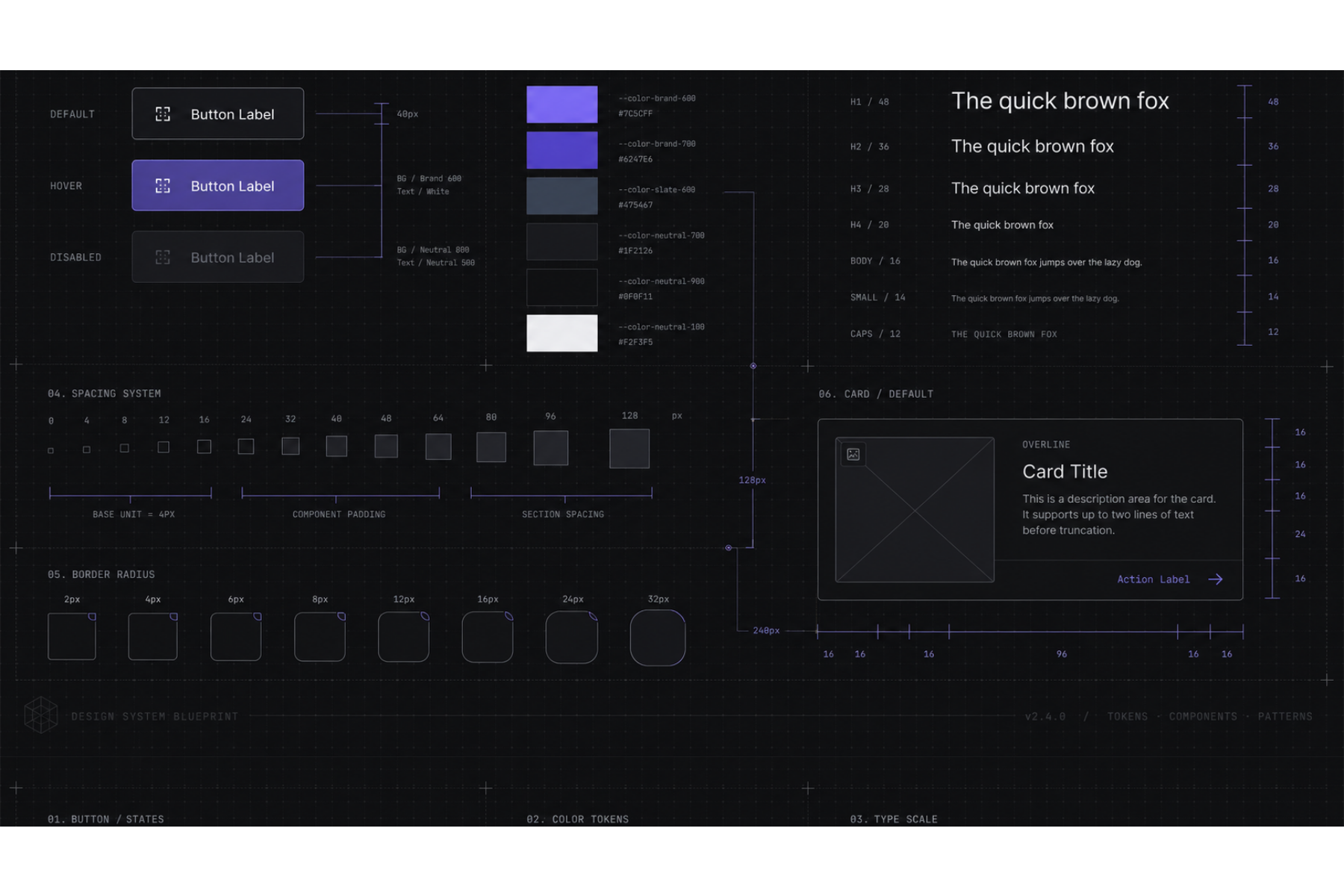
Ever used a product and thought, this just feels right — every button, every spacing choice, every loading state seemingly made by the same careful hand? That's rarely luck. Behind it is almost always a design system quietly doing its job: holding the product's memory so that no single person has to. Design systems are one of those things that get underestimated until they're missing. Build without one long enough and you'll find yourself with three slightly different shades of blue that all mean "primary," buttons that don't quite match across pages, and a new engineer spending two days figuring out how modals are supposed to behave. The chaos is slow, invisible, and expensive. This note is a reflection on what design systems actually are at their core — not just technically, but philosophically — and why investing in one is really an investment in the long-term quality of everything your team ships.
What Is a Design System, Really?
Most definitions start with the artefacts: a component library, a token set, a Figma file, a documentation site. And yes, those things are the design system. But that framing puts the focus on the output when the more interesting question is about the intent. A design system is a set of shared decisions that have already been made. It answers questions before they're even asked — what does a destructive action look like? How much spacing sits between a label and its input? What does "disabled" feel like across an entire product? Every time a developer or designer doesn't have to re-litigate those questions, the system is working.
"A design system is a living agreement between design and engineering — one that says: we've thought about this, so you don't have to think about it again."
That's why it functions as memory. It encodes the decisions, the reasoning, and the constraints of the people who came before — and makes them available to everyone who comes after.
The Memory Metaphor — Why It Fits
Products grow. Teams change. The designer who agonised over the primary action button's border-radius leaves for another company. The engineer who knew exactly why the toast notification sat 16px from the bottom edge gets promoted and stops writing CSS. Without a system, their knowledge evaporates. With one, it persists. Think of a design system as the difference between a city with a planning code and a city without one. No code, and every new building makes independent decisions about height, setback, and material — the result is incoherence over time. With one, new buildings slot into a living framework, and the city remains legible even as it grows. Your product is the city. The design system is the planning code.
"Consistency isn't just an aesthetic virtue — it's a trust signal. Users learn your product's language once, and then they expect it to hold."
When it doesn't hold — when the same action triggers different feedback depending on which screen you're on — users feel it, even if they can't name it. The trust erodes at a level below conscious thought.
The Consistency Problem (And Why It's Harder Than It Looks)
Consistency at the component level is relatively easy to achieve. The hard part is consistency of behaviour, tone, and decision-making across an entire product surface over time. Without a system, consistency becomes a person-dependent property. It lives inside the heads of your most senior team members. That's fragile. The moment a team scales past a handful of people, or parallel squads start shipping features independently, drift begins. Not because anyone is doing bad work — because there's no shared reference to anchor against. Design systems solve this by making the reference external and explicit. The "source of truth" stops being a person and starts being a system — something that can be updated, versioned, and consulted by anyone on the team. A few things that genuinely break down without a system:
None of these are catastrophic alone. Together, they degrade the product into something that feels assembled rather than designed.
Tokens, Components, and the Architecture of Trust
The technical backbone of a modern design system usually has two layers: Design tokens are the raw values — colours, spacing scales, type sizes, border radii, elevation levels. They're the atoms. A good token system is semantic: color.action.primary communicates intent in a way that #5B4FCF never can. When you need to update the primary brand colour, you change one token and it propagates everywhere. Components are the molecules — built from tokens, encoding interaction patterns and accessibility requirements, and tested across contexts. A Button component isn't just a styled <button> element; it's a contract. It handles focus, disabled states, loading states, and size variants consistently, every time it's used. The relationship between tokens and components is where the architecture of trust lives. If tokens are the planning code, components are the pre-approved building types — things you know will slot correctly into the city because they were designed to.
"The best design systems are invisible to end users and invaluable to the teams building for them."
This is the quiet magic. Users never see the token. They never know a Card component was reused forty times across the product. They just feel — without being able to say why — that this product knows what it's doing.
When Design Systems Break Down
A design system that nobody uses is a Figma file, not a system. This is worth naming honestly: systems fail. And they usually fail in one of three ways. Governance lag — The system doesn't keep up with the product. Components get built one-off in the product codebase and never contributed back. The system becomes a museum of outdated patterns while the real source of truth drifts back into individual files. Too much rigidity — The system becomes a bureaucracy. Teams want to ship, the system team becomes a bottleneck, and squads start working around it. A good system bends without breaking — it offers escape hatches and extension patterns alongside its opinions. No ownership — A design system is a product. It needs a roadmap, a team (even a small one), and dedicated time. Systems maintained "on the side" by people with other jobs slowly calcify. The antidote to all three is treating a design system the way you'd treat any critical product: with dedicated care, clear ownership, and genuine investment in its users — who happen to be your colleagues.
A design system is institutional product memory
It encodes decisions made by people who may no longer be on the team and makes them available to everyone building on the product today and tomorrow.
Consistency is a trust signal, not just an aesthetic choice
Users absorb incoherence even when they can't articulate it; a design system keeps the product speaking one language across every surface and interaction.
The real ROI is speed through shared vocabulary
The investment feels slow at first, but a well-maintained system compounds into dramatically faster design, development, and onboarding over time.
Design systems rarely get the credit they deserve because their best work is invisible. No one opens an app and thinks "great token architecture." But they feel it — in the confidence of every interaction, the predictability of every pattern, the quiet sense that someone thought carefully about this before they arrived. If you're building something meant to last, a design system isn't a nice-to-have. It's how you scale care.