From Idea to Shipped: What Thoughtful Products Actually Need
A developer's honest field notes on navigating the messy, rewarding gap between "what if we built this?" and the moment your users actually have it.
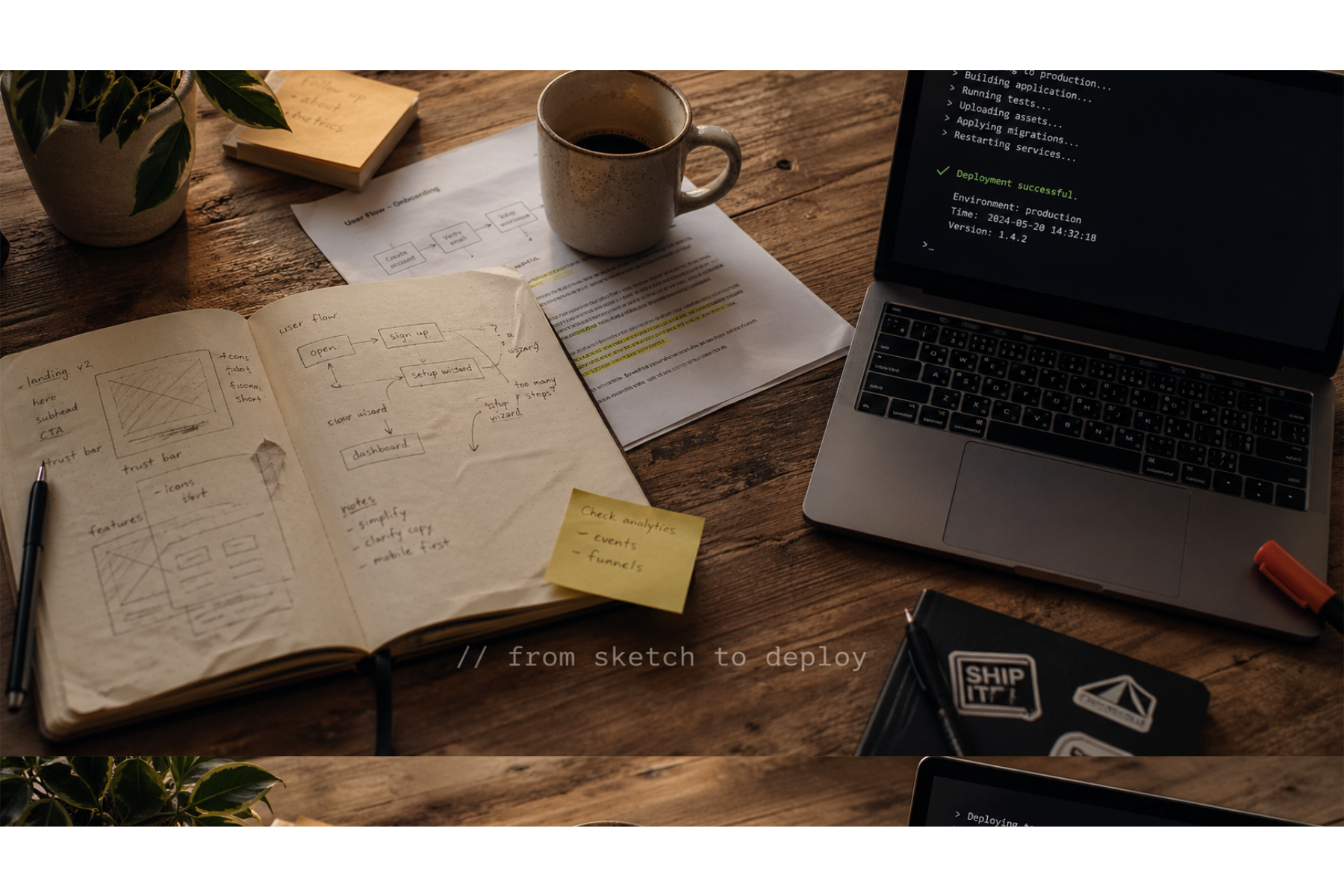
Every shipped product has a graveyard behind it — discarded ideas, renamed files, features that felt brilliant at 2am and broken by morning standup. The journey from a concept sketch to something real that users actually touch is rarely a straight line. It's iterative, occasionally chaotic, and deeply human. This journal entry is a practical look at the parts of that journey that matter most: clarity of intent, the discipline of iteration, and the underrated craft of knowing when — and how — to release.
The Idea Isn't the Product — Clarity Is
Most product failures don't start with bad execution. They start with fuzzy intent. A great idea written on a napkin is still just a napkin. What separates a concept that ships from one that rots in a Notion doc is the work of making it legible — to yourself, your team, and eventually your users. Before writing a single line of code, the most valuable thing you can do is answer three questions with uncomfortable precision: Who is this for? What frustrating reality does it fix? And what does "done" actually look like? If you can't answer all three in plain language, the ambiguity will show up in your code, your sprint reviews, and your user feedback.
"A product that tries to solve everything for everyone solves nothing well for anyone."
The best product decisions aren't technical — they're editorial. They're choices about what to cut, what to delay, and what genuinely belongs in v1.
Sketches Before Sprints — Why Low-Fidelity Thinking Saves High-Fidelity Time
There's a trap in modern development tooling: it's so good, it tempts you to build before you've properly thought. Jumping into a full component library or a database schema before validating a user flow is one of the most expensive mistakes a team can make — not because the code is wasted, but because the thinking gets locked into the wrong shape. Low-fidelity sketches — rough wireframes, whiteboard flows, even paper prototypes — create space for challenge without the psychological weight of "we already built this." They're cheap to discard, fast to modify, and surprisingly effective at surfacing gaps in your assumptions.
"The goal of the sketch phase isn't to plan the product — it's to expose what you don't yet know about it."
Reserve your high-fidelity energy for problems you've already validated. It's not slowing down; it's front-loading your learning curve.
Iteration Is a Discipline, Not a Default
"We're iterating" can mean two entirely different things depending on the team. For one, it means a structured loop of build → measure → learn → adjust. For another, it means endlessly tweaking without ever committing. The first is a superpower. The second is a symptom. Healthy iteration has a rhythm. Each cycle should have a specific question it's trying to answer — not just "make it better," but "does this navigation pattern reduce drop-off at the onboarding step?" Without a clear hypothesis, you're not iterating; you're guessing with extra steps. The habit of writing down what you're trying to learn before you build is one of the most underused practices in product development. Even a one-sentence "we believe X" written in a PR description changes the quality of the review that follows.
Release Discipline — The Last 10% Nobody Talks About
The final stretch from feature-complete to actually-shipped is where many products quietly die or silently degrade. Release discipline is the set of habits and standards that close that gap consistently. It includes the obvious things: testing, staging environments, changelogs. But the subtle side of it is just as important — things like feature flags to control rollout risk, clear internal sign-off criteria that don't shift at the last minute, and the team norm of not adding scope in the final 48 hours.
"Shipping is a habit. The teams who do it well aren't lucky — they've just removed the friction from their release process until it feels boring. Boring deploys are good deploys."
One useful heuristic: if you can't describe the release in three sentences to a non-technical stakeholder, the release isn't ready. Clarity of communication at the point of shipping is a signal, not just a formality.
The Feedback Loop That Ships Better Products
Shipping isn't the end of the journey — it's the beginning of the next one. The real competitive edge for any product team lies in how well they close the loop between what they shipped and what they learn from it in production. Good feedback loops are designed, not hoped for. That means instrumentation before launch, not as an afterthought. It means defining what signals constitute success — not just "users aren't complaining." And it means building a lightweight culture of post-ship reflection: what worked, what broke earlier than expected, what the next smart iteration looks like. The teams that consistently build thoughtful products aren't the ones with the best ideas. They're the ones who've structured their process to turn every ship into a learning event.
Clarity before code
The most expensive bugs in any product aren't in the codebase — they're in the brief. Invest disproportionately in defining the problem before solving it.
Iteration needs a hypothesis
Cycling through changes without a learning goal isn't iteration — it's drift. Even a simple "we think this change will improve X because Y" sharpens every sprint.
Boring releases are the goal
The teams shipping most reliably have made their release process so systematic it feels routine. Remove friction, define your criteria, and protect your final stretch from scope creep.
Building products is one of the most satisfying creative acts in software — and one of the most humbling. The gap between idea and shipped is where the real craft lives. Not in any single breakthrough, but in the accumulated decisions to stay clear, stay iterative, and keep shipping with discipline. The sketch becomes the spec, the spec becomes the build, and the build becomes something someone actually uses. That's still kind of magic, even when you've done it a hundred times. Keep building. Ship the thing.