Engineering for Trust: The Systems Behind Secure Products
A practical look at how thoughtful authentication, authorization, and data boundary design turn security from a feature into a feeling — one your users never have to think about.
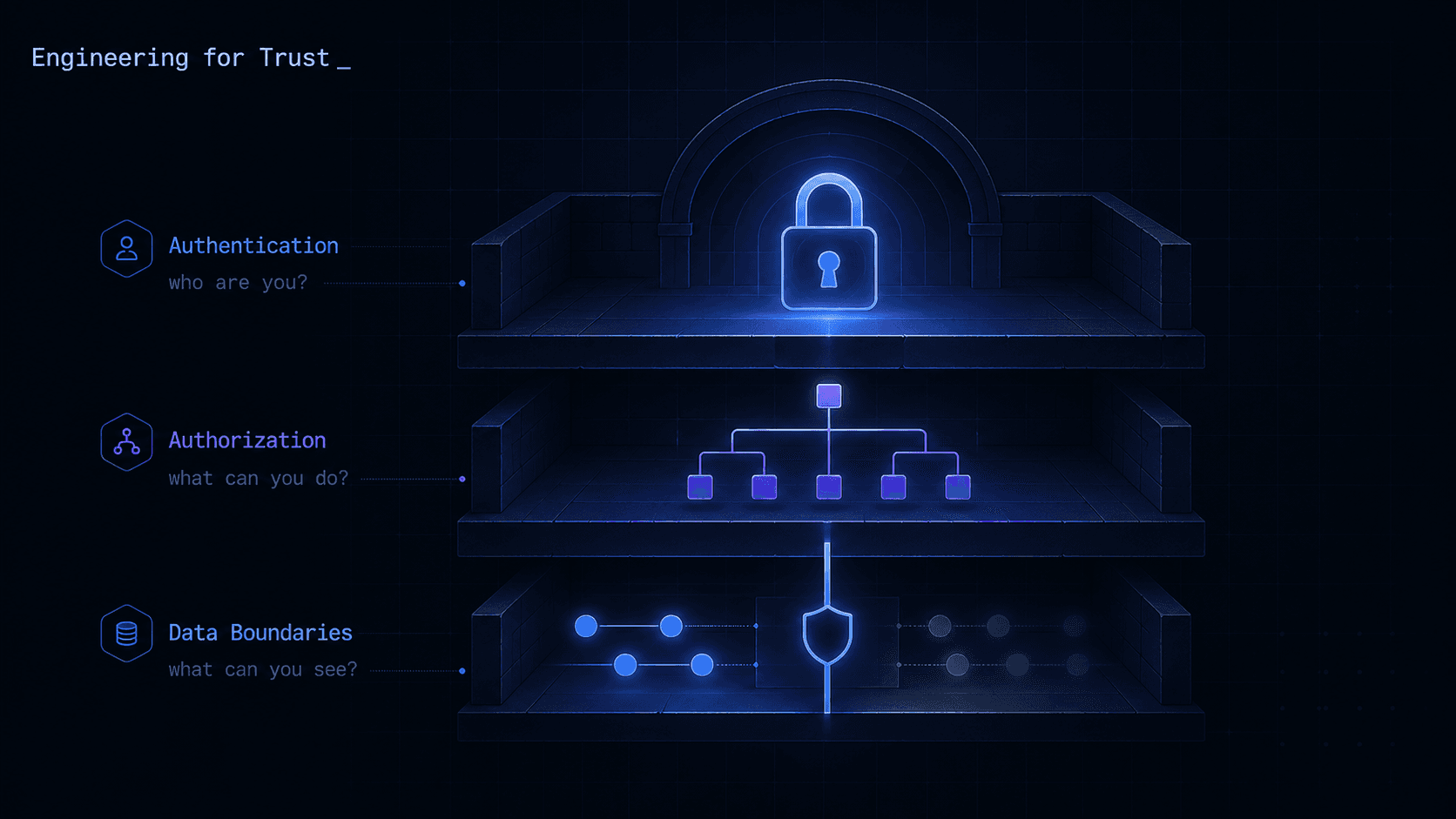
There's a moment every developer knows. You ship something, it works, and then a tiny voice whispers: "But is it actually safe?" Security isn't a feature you bolt on at the end of a sprint. It's the quiet infrastructure underneath everything — the difference between software that users trust instinctively and software that makes them nervous without knowing why. When a product feels reliable and predictable, that feeling is almost always the result of deliberate engineering decisions made long before any user touched the interface. This journal note is a walkthrough of the core systems I think about when building for trust: authentication, authorization, and data boundaries. Not the theory — the thinking.
The Three Pillars of a Trustworthy System
Every secure product I've worked on rests on three distinct concerns, and the first mistake teams make is conflating them: Authentication answers: Who are you? Authorization answers: What are you allowed to do? Data Boundaries answer: What can you even see? These aren't the same problem, and they don't deserve the same solution. A system that handles all three as one blob of middleware is a system that will eventually surprise you — and usually not in a good way.
"Security is not about perfection. It's about raising the cost of failure high enough that most attackers move on."
Each pillar deserves its own clear ownership in the codebase, its own failure mode analysis, and its own contract with the rest of the system.
Authentication: The Front Door
Authentication is where most teams spend the most effort, and rightfully so — it's the front door. But a well-designed front door isn't just a strong lock. It's also clear signage, a visible handle, and an obvious way to knock. The mistakes I see most often aren't cryptographic failures. They're UX failures that erode trust: sessions that expire without warning, MFA flows that punish users for switching devices, "forgot password" journeys that take five minutes. A user who feels frustrated by your login is a user who feels unsafe — even if nothing is technically wrong. A few principles that hold up well in practice:
"The goal of authentication design is that users should feel confident, not interrogated."
Data Boundaries: The Invisible Architecture
This is the least-discussed pillar and, in my experience, the one most likely to cause a serious incident. Data boundaries are about ensuring that even if authentication and authorization are perfect, the shape of your data doesn't leak information it shouldn't. This means:
The thing I've come to believe strongly: data boundaries should be enforced as close to the data as possible. Enforcing them only at the API layer means a future developer adding a new endpoint accidentally inherits a bypass. Enforcing them at the ORM, query, or storage layer means the protection travels with the data.
"The most dangerous assumption in security engineering is that someone else already handled it."
Making Security Feel Like Nothing
Here's the counterintuitive part: when you've done all of this well, users shouldn't notice. Security that calls attention to itself has usually failed somewhere — either it's too restrictive (creating friction) or it had to intervene loudly (because something went wrong). The goal is ambient trust — that feeling when you're using software and you just... don't worry. Passwords are remembered without risk. Sessions end gracefully. Your data is yours. That feeling isn't magic. It's the result of hundreds of small, careful decisions made by engineers who thought about what could go wrong and then made it not go wrong quietly.
Separate your concerns cleanly
Authentication, authorization, and data boundaries are three distinct problems. Treating them as one creates systems that are hard to audit, hard to debug, and hard to extend safely.
Enforce constraints as close to the data as possible
API-layer-only authorization is fragile. The closer your enforcement is to the source of truth, the harder it is to accidentally bypass.
Security should feel like nothing
Friction, confusion, and loud interventions are signals that the design needs work — not that users need to try harder.
Security engineering isn't about being paranoid. It's about being intentional — about making deliberate decisions so that the default state of your system is safe, even when something unexpected happens. The authentication flows, authorization policies, and data boundaries you design today are the invisible infrastructure that users will rely on without ever knowing it exists. That anonymity is the goal. Build things that feel safe because they are.